Best Grow Lights UK 2026

Home grower and obsessive researcher. Years in commercial product sourcing means I evaluate growing equipment the way a buyer does — specs, build quality, and real-world performance, not marketing claims.
Just so you know, some links on this page are affiliate links. If you buy something via them, we get a small kickback. You don't pay more, but it helps toward seeds and kit.
Everything else in a hydroponic system can be optimised after the fact — you can upgrade nutrients, switch systems, dial in your pH. But light is foundational. Too little and plants reach desperately toward whatever source exists, growing pale and leggy. Too much of the wrong kind wastes electricity without improving growth. Get lighting right and the rest of the system rewards you quickly.
Quick Picks: Best Grow Lights UK 2026
Not sure which setup is right for you?
Take Our QuizThe honest truth: Unless you're growing in a south-facing conservatory in summer, you need grow lights for indoor hydroponics in the UK. Our winters are dark. Even good windows don't provide enough light for most edibles between October and March.
Why Lighting Matters More Than You Think
Plants convert light into energy through photosynthesis. Too little light means weak, leggy plants that struggle to produce. The right spectrum and intensity determines your success more than almost any other factor.
We learned this the hard way. My first indoor basil plants stretched toward the window, grew spindly stems, and produced pale, flavourless leaves. Same seeds, same nutrients, same everything - the only variable was light. Adding a proper grow light transformed the results.
Indoor UK conditions present a real challenge. South-facing windows help, but even these provide insufficient light for vegetables during our darker months. Grow lights bridge this gap, enabling year-round production regardless of weather or season.
LED vs HPS: The Real Comparison
This debate generates more heat than the lights themselves. Here's the practical breakdown.
LED Grow Lights
Modern LEDs have transformed indoor growing. They produce intense, full-spectrum light while running cool and efficient. The upfront cost is higher, but energy savings compound over time.
Key advantages: - 40-50% lower electricity consumption than equivalent HPS - Minimal heat output means easier temperature control - 50,000-100,000 hour lifespan means no bulb replacements for years - Full spectrum covers all growth stages without changing bulbs - Silent operation with no cooling fans on many models
The Spider Farmer SF2000 EVO exemplifies modern LED technology. Samsung LM301H EVO diodes achieve excellent efficiency. 200W actual draw covers a 120x60cm area for mixed vegetables. Silent operation, dimmable, 3-year warranty.
HPS (High Pressure Sodium)
Traditional choice for commercial operations and experienced growers. HPS excels at light penetration and proven flowering results, but generates significant heat and higher electricity bills.
Key considerations: - Lower upfront cost than equivalent LED - Excellent light penetration for dense canopies - Requires proper ventilation for heat management - Bulb replacement every 12-18 months at around £30-50 per bulb - Higher electricity consumption - a 600W HPS costs roughly £50-60 per month to run
The LUMii BLACK 600W kit is exceptional value for growers with proper ventilation who prioritise yield over running costs. It's a complete kit with digital ballast and reflector.
Which Should You Choose?
For most home growers, LED makes sense. The efficiency savings cover the higher purchase price within 12-18 months. Less heat means simpler ventilation. Longer lifespan means fewer replacements.
HPS still has a place if you're growing in a garage or shed where the heat is actually welcome in winter, or if you're on a tight initial budget and have good ventilation already sorted.
Understanding Wattage and Coverage
Ignore "equivalent wattage" marketing claims. Focus on actual power draw. A quality 200W LED produces more usable light than a cheap 200W LED. Brand and diode quality matter.
Coverage guidelines for quality LEDs:
| Actual Wattage | Coverage Area | Suitable For |
|---|---|---|
| 50-100W | 60x60cm | Herbs, seedlings |
| 150-200W | 120x60cm | Mixed vegetables |
| 250-300W | 120x90cm | Fruiting plants |
| 400W+ | 120x120cm+ | Serious production |
More light enables denser planting and faster growth, but returns diminish beyond certain thresholds. Most home setups optimise at 150-300W actual draw. Going bigger than necessary wastes electricity without improving results.
UK Electricity Costs: What You'll Actually Pay
At current UK rates of approximately 28p per kWh, here's what different setups cost to run:
| Light Type | Power | Daily (16hr) | Monthly Cost |
|---|---|---|---|
| VIVOSUN 100W LED | 100W | 1.6kWh | Around £13 |
| Spider Farmer 200W | 200W | 3.2kWh | Around £27 |
| Spider Farmer 400W | 400W | 6.4kWh | Around £54 |
| HPS 600W | 660W | 10.56kWh | Around £89 |
The 200W LED vs 600W HPS comparison is stark: roughly £60 per month difference in running costs. Over 12 months, that's around £720 saved - more than enough to cover the LED's higher purchase price.
Spectrum Considerations
Full spectrum "white" LEDs work for all growth stages. The debate over specific spectral ratios matters less for vegetables than for certain flowering crops.
What the science shows: - Blue light (400-500nm) promotes compact, leafy growth. Higher blue ratios keep plants shorter and leafier — useful for herbs you want bushy rather than leggy. - Red light (600-700nm) drives photosynthesis efficiency. The 660nm peak is particularly effective at driving chlorophyll absorption. - Far-red (700-760nm) can boost flowering responses and extend the Emerson effect — marginally useful for fruiting crops, irrelevant for herbs and lettuce. - Green light (500-600nm) penetrates deeper into the canopy than red or blue, useful in dense multi-layer growing.
Quality full-spectrum LEDs include appropriate ratios of all wavelengths. The Spider Farmer SF2000 EVO includes 3000K warm, 5000K cool, 660nm red, and 760nm IR for comprehensive coverage.
Colour temperature (Kelvin) explained:
The K number on LED specs describes the warmth or coolness of white light. Higher K (5000-6500K) is cooler and bluer — good for vegetative growth. Lower K (2700-3000K) is warmer and redder — better for flowering and fruiting. Full-spectrum fixtures blend both, which is why they work across all growth stages without adjustment.
Red/blue "blurple" lights:
Older LED grow lights used only red and blue LEDs, producing the distinctive purple glow. They work, but full-spectrum white LEDs have overtaken them on efficiency and usability. Modern white-spectrum LEDs are easier to work under (you can actually see what's happening to your plants), and the efficiency gap has closed considerably.
Does spectrum matter for UK home growers?
For herbs, lettuce, and most vegetables, a standard full-spectrum white LED works brilliantly. Don’t overthink spectrum unless you’re growing specific flowering crops with particular requirements. The gains from spectrum optimisation are real but secondary to having adequate intensity (PPFD) and correct photoperiod. Get those right first.
What to Avoid
Blurple (Purple) LEDs: Older technology using primarily red and blue diodes. Less efficient than modern full-spectrum white LEDs. The purple light makes plant health assessment difficult because you can't see true leaf colour. Skip these regardless of price.
Unbranded Amazon specials under £40: Extremely cheap lights often use low-quality diodes that dim rapidly. Customer support is non-existent when they fail. Poor efficiency means higher long-term costs despite low purchase price.
Overpowered for your space: A 400W light in a 60x60cm tent wastes electricity and creates heat issues. Match wattage to growing area.
Lights without proper heat sinks: Cheap LEDs run hot because they lack adequate cooling. This shortens lifespan and can damage plants if hung too close.
Heat Management
HPS lights convert roughly 60% of energy into heat. A 600W HPS adds significant thermal load requiring extraction and potentially air conditioning in summer.
LEDs run dramatically cooler. A 200W LED produces manageable heat that a small tent fan handles easily. This simplifies setup and reduces equipment costs.
Consider your space: Loft grows in summer need LED efficiency. Garage setups in British winters might benefit from HPS heat contribution. Match the technology to your environment.
My Top Recommendations
**Best Budget Option: VIVOSUN A100SE* 100W actual draw covers 60x60cm effectively. Integrated circulation fan improves canopy airflow. App control via GrowHub adds convenience. Ideal for herb gardens and small salad operations. (Price when reviewed: ~£106 | Check Price on Amazon)*
**Best Overall: Spider Farmer SF2000 EVO* Samsung LM301H EVO diodes deliver industry-leading efficiency. 200W covers 120x60cm for mixed vegetables. Silent operation, dimmable driver, 3-year support. The benchmark for serious hobby growing. (Price when reviewed: ~£183 | Check Price on Amazon)*
Best Value HPS: LUMii BLACK 600W For growers with proper ventilation prioritising yield over running costs. Complete kit with digital ballast. Requires extraction fan and heat management. Best suited to experienced growers with dedicated spaces. (Price when reviewed: ~£57 | Check Price on Amazon)
**Best for Small Spaces: Spider Farmer SF1000* 100W in a compact form factor. Same quality diodes as the larger models. Perfect for 60x60cm tents or shelf setups. (Price when reviewed: ~£90 | Check Price on Amazon)*
Understanding PPFD and PAR
Marketing figures (watts, "equivalent watts") tell you very little about a light's actual performance. The numbers that matter are PAR and PPFD.
PAR (Photosynthetically Active Radiation): The wavelengths of light plants actually use for photosynthesis, roughly 400-700nm. Not all light in this range is equally useful — which is why spectrum composition matters beyond raw wattage.
PPFD (Photosynthetic Photon Flux Density): Measures how many photons in the PAR range land on a given area per second. Units: µmol/m²/s. This is the real measure of light intensity your plants receive.
Target PPFD by crop and stage:
| Crop Type | Seedlings | Vegetative | Flowering/Fruiting |
|---|---|---|---|
| Leafy greens and herbs | 150-250 | 200-400 | Not applicable |
| Fruiting plants (tomatoes, peppers) | 150-200 | 400-600 | 600-900 |
| High-light fruiting | 200-300 | 600-900 | 900-1200 |
For herbs and salad greens, 200-400 PPFD is entirely adequate. Tomatoes fruiting need 600-900. The Spider Farmer SF2000 at 45cm height delivers roughly 900 µmol/m²/s at the centre of its coverage area — more than adequate for fruiting crops.
Quality lights publish verified PPFD maps. Be sceptical of any light without published test data. Third-party testing (Migro on YouTube, for instance) is more reliable than manufacturer claims.
CMH/CDL: The Third Option
Beyond LED and HPS there's CMH (Ceramic Metal Halide), also called CDL or LEC. These produce a balanced, full-spectrum light with very high CRI — the colour looks almost like natural daylight, which makes assessing plant health genuinely easy compared to the purple glow of older LEDs.
Advantages: - Spectrum closer to natural sunlight than HPS - Good light penetration for dense canopies - Lower heat output than equivalent HPS - Bulb lifespan around 20,000 hours
Disadvantages: - Less efficient than modern LED - Requires a compatible ballast and fixture - Less widely available than LED or HPS - Still generates meaningful heat — ventilation required
CMH is a reasonable option if you're upgrading from HPS but not ready for full LED investment, or if you're growing in a cold space where some heat output is welcome. Not the first choice for most new setups, but worth knowing exists.
Choosing Lights for Specific Crops
Different crops have different light requirements. Matching your light to what you're actually growing avoids overspending and improves results.
Herbs and leafy greens (lettuce, basil, spinach, coriander): Low-medium light requirement. 200-400 PPFD is sufficient for strong growth. A 100W LED covers 60x60cm effectively. There's no benefit to running 300W+ for a herb shelf — you'll spend more on electricity and create heat problems.
Tomatoes and peppers: High light requirement during fruiting. Target 600-900 PPFD once flowering begins. A 200W LED covers one or two plants adequately. For four plants fruiting simultaneously, 300-400W produces noticeably better yields.
Strawberries: Moderate requirement. Similar to herbs during vegetative growth, slightly higher during fruiting. A 150-200W LED covers a reasonable strawberry bed of 4-6 plants.
Microgreens: Surprisingly low light requirements despite rapid growth. 100-200 PPFD is adequate. A compact LED or even a T5 fluorescent works well. Microgreens don't need the intensity you'd provide to tomatoes.
Seedlings: Keep PPFD at 150-200 maximum, or raise lights significantly higher than for mature plants. Too much intensity on young seedlings causes compact, stressed growth and tip bleaching.
Smart Controls and Dimming
Many modern grow lights include dimmable drivers that let you adjust intensity without changing height. This is more useful than it initially sounds.
Seedlings need lower intensity than mature plants. If your light isn't dimmable, your only option is adjusting height — which changes coverage area and light uniformity, not just intensity. A dimmable light lets you run at 30% for seedlings and 100% for fruiting without moving anything.
The Spider Farmer SF2000 EVO and Mars Hydro FC-E series include dimmable drivers. VIVOSUN's GrowHub-compatible lights can be controlled via phone app with built-in scheduling.
For larger setups, many LED brands support daisy-chaining multiple fixtures from one controller. This means setting a single schedule and intensity level for several lights simultaneously — useful when scaling without managing multiple timers.
For most home setups, a basic mechanical timer at around £10 covers everything needed. Digital timers with programmable schedules are worth the small premium if you want reliable cycle management.
Light schedules by crop:
Leafy greens and herbs grow well under 16 hours on / 8 hours off. This matches long-day conditions and keeps vegetative growth going without triggering flowering. Fruiting crops like tomatoes and peppers benefit from the same 16/8 schedule during vegetative growth, then a shift to 12/12 to trigger flowering and fruiting. This is one area where a programmable timer earns its keep — manually adjusting schedules as crops develop gets tedious quickly.
One practical detail: running lights during off-peak electricity hours (typically overnight) reduces running costs if you're on a time-of-use tariff. A smart plug with scheduling handles this without any special equipment. UK electricity costs for grow lights, and how to calculate your specific running cost, are covered in detail in the electricity costs guide.
Common Questions
Can we use a regular household LED bulb? Not effectively. Household LEDs produce light optimised for human vision — a narrow range peaking around 550nm green. Plants need the full 400-700nm PAR range. A dedicated horticultural LED costing £30-50 produces vastly more usable plant light than any household bulb.
Do I need UV and IR wavelengths? Some premium LEDs include UV (below 400nm) and far-IR (above 760nm). UV can trigger flavour compound and essential oil production in herbs. Far-IR boosts flowering responses. Worth having if included, but not worth paying a large premium for specifically.
Can I leave grow lights on 24 hours? Technically possible, but most plants benefit from a dark period. Herbs and lettuce on 18/6 (18 hours on, 6 off) do well. Fruiting plants typically want 12/12 once flowering starts. Continuous light can stress some plants and cause issues with circadian-linked processes. Use a timer from day one.
My light runs very hot. Is that normal? Modern LEDs should be warm but not hot enough to be uncomfortable to hold. Very hot running indicates inadequate heat sinking (common with cheap lights) or an undersized light running at maximum intensity for extended periods. Check ventilation around the driver unit, and read reviews for that specific model — heat issues are consistently reported by multiple buyers when they exist.
How far should the light be from my plants? It depends on the light's intensity at a given distance — PPFD maps tell you this precisely. As a general starting guide: seedlings at 60-75cm, vegetative growth at 40-60cm, fruiting at 30-50cm. Watch your plants rather than trusting fixed numbers. Upward curling leaves and bleached tips suggest the light is too close. Elongated, reaching stems suggest it's too far away or insufficient intensity.
Do lights need replacing regularly? Quality LEDs degrade very slowly. Expect 10-15% reduction in output after 50,000 hours of use — that's over 8 years running 16 hours daily. HPS bulbs degrade much faster and need replacing every 12-18 months. This ongoing replacement cost is often overlooked when comparing HPS and LED purchase prices.
Want to understand what your lights will cost to run? Our electricity costs breakdown has real numbers for every setup size. And if you're setting up a tent, the grow tent setup guide covers ventilation and climate control alongside lighting.
Take our quiz to get lighting recommendations matched to your specific growing goals, space constraints, and budget.
The shift from HPS to LED over the past decade is one of the most significant changes in indoor growing — and it's almost entirely in favour of home growers. The efficiency gains are real, the heat reduction is real, and the lifespan advantage compounds over years. Whatever light you choose, buy quality diodes and a proper heat sink. Cheap LEDs are the one area where the price difference genuinely matters.
What You'll Need With It
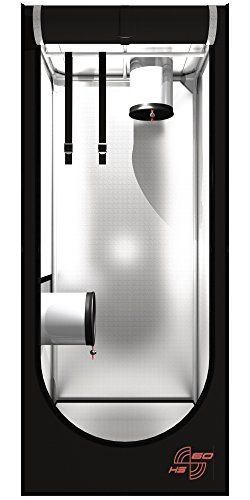
Professional grow tent with reflective mylar interior. 60x60cm footprint, 140cm height. Ideal for small NFT or DWC setups.

Quiet inline fan for grow tent ventilation. 100mm diameter with speed controller. Essential for temperature and humidity management.

Premium carbon filter for odor control. 100mm diameter, connects to inline fan. Essential for indoor growing in shared spaces.
Products Mentioned in This Guide
Find Your Perfect Setup
Answer a few quick questions and get personalised recommendations.
Start the QuizFrequently Asked Questions
Related Guides
Ready to find your perfect setup?
Our quiz matches you with the right system, lights, and supplies.
Take the Quiz - It's FreeNo email required